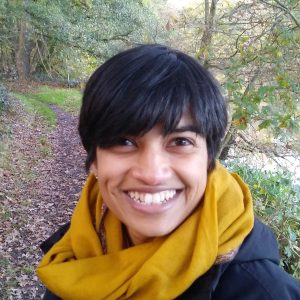
 Geetha Iyer received an MFA in Creative Writing & Environment from Iowa State University in 2014. She works as an Assistant Professor of English at Northern Arizona University, in Flagstaff, where she teaches creative writing that is inextricable from place, people, and ecologies in flux. She is the Associate Editor of Creative Nonfiction at ISLE: Interdisciplinary Studies in Literature and Environment, and is enjoying a brief stint as volunteer editor at Crucial Comix. She was the inaugural Mellon Science and Nature Writing Fellow at Kenyon College from 2020-2023, where she wrote and taught about intersections between the sciences and the arts through ecocritical and postcolonial lenses.
She writes fiction, poetry, and nonfiction, with work appearing or forthcoming in journals including Gulf Coast, Orion, Ecotone, Story, Electric Literature, The Missouri Review Online, The Forge, Mid-American Review, Territory, Split Lip, The Account, National Geographic, The Massachusetts Review, and Indiana Review. Recognition for her writing includes: the 2016 O. Henry Award, the 2014-2015 James Wright Poetry Award, the 2013 Calvino Prize, the 2012 Gulf Coast Fiction Prize, a work-study scholarship from the Bread Loaf Writer’s Conference, and the Hopwood Award and Robert F. Haugh Prize for undergraduate short fiction from the University of Michigan. She has held residencies through the SciArt Initiative’s virtual, cross-disciplinary program, “The Bridge: Experiments in Science & Art,” Estudio Nuboso’s collaborative Art + Science Lab in Panama City, Panama, and the Sitka Center for Art and Ecology in Oregon, USA.
She has a multidisciplinary background in arts and sciences. She received a Master of Forest Resources and Conservation degree from the University of Florida in 2010, with a focus on environmental education. She received a dual Bachelor of Sciences degree in biology and English from the University of Michigan in 2007. She is passionate about community arts, science literacy, and social and environmental justice. She was born in India and grew up in the United Arab Emirates. She lived in Panama for six years before moving to the United States midway through the pandemic.
She recently finished work on an essay collection, Love Songs in Other Languages, a country-hopping self-portrait in natural history observations. In other words:
A song is a poem a prayer a wish an elegy a spiriting a memory a means of moving through the world. Love Songs in Other Languages treats personal life and natural life as braided entities. The author travels between countries in Asia and the Americas and tracks forms of dis/connection through trees, frogs, bees, tigers, butterflies, gorillas, spiders, family, and other forms of life. Midway through these journeys, the world goes into lockdown, and these essays explore nature and social connection from the vacuum of isolation caused by the Covid-19 pandemic. Ranging from lyric essays to science writing, speculative nonfiction to memoir, this research-driven essay collection brings the author’s world together through birdsong, radio music, multilingual chatter, pregnant pauses, non-human body language, the growth patterns of tropical rainforests, and other forms of natural music.
She continues to work on:
- A collection of nonfiction essays (tentatively titled, Animal Minds) about the diversity of ways in which animals think, learn, play, explore, and more, and how an understanding of the science of animal cognition might feed into creative writing.
- A short story collection (tentatively titled, Continental Drift) about natural history archivists, sociopathic artists, girls who might be time-travelers, and languages that might be alive.
Book-length projects on the back burner:
- A novel-in-stories, Resident Aliens, about a family fracturing as they search for different ideas of home—on Mars, in the West, in the woods, in the past. A boy dreams of a way out of school. A girl becomes foreign to herself. A security guard wants to be an astronaut. A tailor has no time for haute couture.
- A poetry collection, Mapping the Tongue, which started with a Tamil dictionary, a recipe for curried bananas, and scientific papers on invasive species, and is now concerned with all the ways language cannot classify experience.

 Geetha Iyer